Water supply and sanitation in Malaysia is characterized by numerous achievements, as well as some challenges. Universal access to water supply at affordable tariffs is a substantial achievement. The government has also shown a commitment to make the sector more efficient, to create a sustainable funding mechanism and to improve the customer orientation of service providers through sector reforms enacted in 2006. The reform creates a modern institutional structure for the water sector, including an autonomous regulatory agency, an asset holding company and commercialized state water companies that have to reach certain key performance indicators that will be monitored by the regulatory agency. The government has also stated its intention not to embark on new private sector contracts for water provision, after a bout of such contracts during the 1990s showed mixed results.
A number of challenges remain, only some of which have been addressed by the reforms. First, tariffs are low, thus making cost recovery impossible at current levels so that the sector continues to depend on government subsidies. Second, water losses as well as per capita water use remain high despite efforts at water demand management. Third, a large-scale water transfer project from the Pahang River to Kuala Lumpur is controversial because of its negative social and environmental impacts. Fourth, the development of sewerage and wastewater treatment has lagged behind the development of water infrastructure. For example, much of the collected wastewater is not yet being treated. The sanitation sub-sector has been excluded in the 2006 reforms of the water supply sub-sector.
Thursday, 28 April 2011

Friday, 22 April 2011
WATER RESOURCES AND SUPPLY IN MALAYSIA..
All water sources are dependent on rainfall. Of the total average annual rainfall of about 320bcm for
Peninsular Malaysia some 47% run off as surface flow and is available for use. The total annual demand is
estimated to reach about 14bcm by 2020 which equates to 12% of the total water availability. However,
water supply management and development in Malaysia is not centralised, but is managed on a state-by-state
basis; and to cater for the differences in supply and demand inter-state water transfer programmes have been
implemented. To meet future requirements the National Water Resources Study (2000-2050), recommended
47 new dams and 3 new inter-state water projects among 62 water resource projects, including distribution
systems
Streams or rivers with or without impounding reservoirs contribute about 99% of the raw water for water
supply in Malaysia with the remaining 1% of raw water coming from groundwater. Raw water is extracted at
the intake points along the riverbanks. Dams are constructed along rivers to create reservoirs and water is
drawn from these for water treatment plants throughout the country. The Department of Environment (DOE)
monitors the river basins to determine the water quality in relation to major pollution sources, while the
Ministry of Health (MOH) is responsible for monitoring the raw water quality in the reservoirs at the intake
points of the treatment plants. State Water Authorities or private companies then supply piped drinking water
from the treatment plants to the population.
In rural areas not connected to a treated water supply drinking water is obtained from rivers, ground and rain
water. Clean water from these sources is supplied via gravity feed systems, sanitary wells with or without
house connections, and by the collection of rainwater. Although limited in comparison to surface waters
groundwater still makes a significant contribution in terms of yield and availability, and will be an important
source in meeting future water demands for the public supply.
By the year 2000, 98% of the urban population in Malaysia were served through reticulated systems from
water treatment plants using all or some of the conventional treatment processes of aeration, coagulation and
flocculation, sedimentation, filtration and chlorination. However, the effectiveness of some smaller treatment
plants where only chlorination was used, are now under threat because of development.
By the same year 93.4% of the rural population also had access to safe drinking water, and in areas where the supply was not through treated piped water systems nearly a quarter were supplied with safe water by the MOH under their Rural Environmental Sanitation Programme where systems have been funded in part by
community participation, although in recent years this has been less successful. In areas nearer to towns the
MOH also funds the connection of homes to treated water supplies.
In rural areas potential water sources are identified from areas that have traditionally been known for good
water quality. After identification of such a source the water quality is tested against current standards, and if
found to be suitable is allowed to be used as a drinking water source by the community, however users are
still advised to boil the water before consumption.
Peninsular Malaysia some 47% run off as surface flow and is available for use. The total annual demand is
estimated to reach about 14bcm by 2020 which equates to 12% of the total water availability. However,
water supply management and development in Malaysia is not centralised, but is managed on a state-by-state
basis; and to cater for the differences in supply and demand inter-state water transfer programmes have been
implemented. To meet future requirements the National Water Resources Study (2000-2050), recommended
47 new dams and 3 new inter-state water projects among 62 water resource projects, including distribution
systems
Streams or rivers with or without impounding reservoirs contribute about 99% of the raw water for water
supply in Malaysia with the remaining 1% of raw water coming from groundwater. Raw water is extracted at
the intake points along the riverbanks. Dams are constructed along rivers to create reservoirs and water is
drawn from these for water treatment plants throughout the country. The Department of Environment (DOE)
monitors the river basins to determine the water quality in relation to major pollution sources, while the
Ministry of Health (MOH) is responsible for monitoring the raw water quality in the reservoirs at the intake
points of the treatment plants. State Water Authorities or private companies then supply piped drinking water
from the treatment plants to the population.
In rural areas not connected to a treated water supply drinking water is obtained from rivers, ground and rain
water. Clean water from these sources is supplied via gravity feed systems, sanitary wells with or without
house connections, and by the collection of rainwater. Although limited in comparison to surface waters
groundwater still makes a significant contribution in terms of yield and availability, and will be an important
source in meeting future water demands for the public supply.
By the year 2000, 98% of the urban population in Malaysia were served through reticulated systems from
water treatment plants using all or some of the conventional treatment processes of aeration, coagulation and
flocculation, sedimentation, filtration and chlorination. However, the effectiveness of some smaller treatment
plants where only chlorination was used, are now under threat because of development.
By the same year 93.4% of the rural population also had access to safe drinking water, and in areas where the supply was not through treated piped water systems nearly a quarter were supplied with safe water by the MOH under their Rural Environmental Sanitation Programme where systems have been funded in part by
community participation, although in recent years this has been less successful. In areas nearer to towns the
MOH also funds the connection of homes to treated water supplies.
In rural areas potential water sources are identified from areas that have traditionally been known for good
water quality. After identification of such a source the water quality is tested against current standards, and if
found to be suitable is allowed to be used as a drinking water source by the community, however users are
still advised to boil the water before consumption.
Wednesday, 20 April 2011
ANIMALS AND WATER ...
Water is the most important nutrient in animal feeding and animal health. It is the most abundant ingredient of the animal body in all phases of growth and development. A calf's body contains 75 to 80% water at birth and about 55 to 65% water at maturity. Of all farm animals, lactating dairy cows require the greatest amount of water in proportion to their size because water constitutes 86 to 88% of the milk they yield.
 Sources of water include that obtained from the ground or surface, water in the feed supply and metabolic water obtained from the oxidation of fat and protein in the body. Water intake usually refers to free-drinking water plus that available in the feed.

THE IMPORTANCE OF DRINKING WATER..
What exactly is the importance of drinking water in the grand scheme of things? When we think about our bodily health, we normally think of exercise and diet. These are important factors, but what may be the most important factor to our health of both mind and body, however, is the amount and quality of water we drink.
Remember you have about 5 quarts of blood and about 50 to 80 quarts of water, you must watch the water you put into your system if you value a VIBRANT HEALTHY BODY. Water is so essential to our body that it's amazing we sometimes overlook its importance.
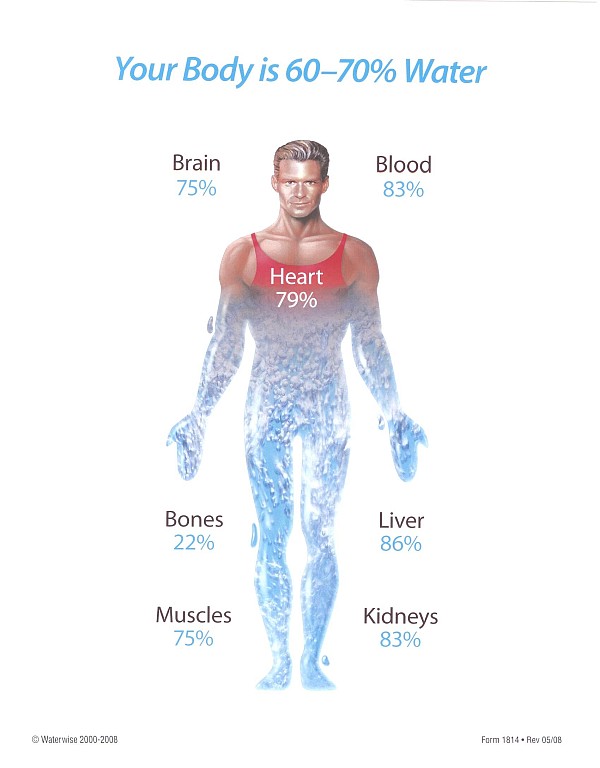
 Did you know that the human body is made up of 70% to 80% water? The brain is made of 75% water and is home to some important glands that have a direct influence on the organs of the body? Muscles 75%, heart 75%, bones 22%, kidneys 83%, lungs 86%, eyes 95%, and your blood 82%. Considering that every drop of blood and water passes through the thyroid gland approximately every 15 minutes of your life, you can imagine the build up of toxins if the water you drink is not of the highest and purest quality. It is essential for the liver and kidneys to have adequate pure water to flush out the toxins that accumulate there.
When you are considering the effects and importance of drinking water, you should be thinking about the big picture. It is absolutely essential for our digestive system--it could not digest food without plenty of water. Ever had a difficult bowel movement or even a painful one? Chances are it was because of a lack of water. We have water flowing all throughout our bodies, so you can imagine that there are many benefits of drinking water daily.
You may be asking yourself now, how much water to drink? The average person should drink about 2-3 quarts of high quality pure water a day. It also depends on your body size, how hot or cold your climate is, humidity, altitude and how much exercise you do. One guide is to take your weight and divide it by half and that will tell you how many ounces to drink. For example a 200lb person should drink 100 ounces.
If you finish a meal and still feel hungry even though you seem to have had enough to eat, it's probably because you are dehydrated. Drink a glass of water and you will be amazed at how quickly your hunger goes away.
 There are endless benefits to drinking enough water. If you drink eight, 8oz glasses of pure water per day, you will be lowering your risk of colon cancer by 45%; most health challenges of the body can be traced back to the colon. As you can tell, pure water is an amazing substance. The importance of drinking water is enormous.
So how can you get the best drinking water? You will want to be careful about the water that comes out of your tap. Although city water districts do a very good job of making sure the tap water is safe to drink when it leaves their facility, studies have shown that our public water sources can be anywhere from mildly polluted to very polluted. This is because of the chemicals and drugs that are dumped into our water sources and miles of pipes the water has to run through. America’s water pipe infrastructure is now very old which is evident by the number of water pipe bursts you hear about in the news. If you are concerned about drinking water for health, then you should look into home water filters or even better distilled water. This is the healthiest choice.
There are so many health benefits to drinking pure water that it is truly amazing, most people only concentrate on the need to satisfy their thirst. Pure water is also essential for relieving stress and tension in the brain. It has also been proven to help reduce anxiety. As a matter of fact, if you are prone to anxiety attacks, a great solution is to drink a few glasses of clean pure water. Water also sharpens our mental functions. This means that it's important to drink plenty of water before big tests, interviews, or any other event that will require you to be at the top of your game.
Find out more about the importance of drinking water and great healthy living tips to sharpen mental function and improve your life.
Remember you have about 5 quarts of blood and about 50 to 80 quarts of water, you must watch the water you put into your system if you value a VIBRANT HEALTHY BODY. Water is so essential to our body that it's amazing we sometimes overlook its importance.
When you are considering the effects and importance of drinking water, you should be thinking about the big picture. It is absolutely essential for our digestive system--it could not digest food without plenty of water. Ever had a difficult bowel movement or even a painful one? Chances are it was because of a lack of water. We have water flowing all throughout our bodies, so you can imagine that there are many benefits of drinking water daily.
You may be asking yourself now, how much water to drink? The average person should drink about 2-3 quarts of high quality pure water a day. It also depends on your body size, how hot or cold your climate is, humidity, altitude and how much exercise you do. One guide is to take your weight and divide it by half and that will tell you how many ounces to drink. For example a 200lb person should drink 100 ounces.
If you finish a meal and still feel hungry even though you seem to have had enough to eat, it's probably because you are dehydrated. Drink a glass of water and you will be amazed at how quickly your hunger goes away.
There are endless benefits to drinking enough water. If you drink eight, 8oz glasses of pure water per day, you will be lowering your risk of colon cancer by 45%; most health challenges of the body can be traced back to the colon. As you can tell, pure water is an amazing substance. The importance of drinking water is enormous.So how can you get the best drinking water? You will want to be careful about the water that comes out of your tap. Although city water districts do a very good job of making sure the tap water is safe to drink when it leaves their facility, studies have shown that our public water sources can be anywhere from mildly polluted to very polluted. This is because of the chemicals and drugs that are dumped into our water sources and miles of pipes the water has to run through. America’s water pipe infrastructure is now very old which is evident by the number of water pipe bursts you hear about in the news. If you are concerned about drinking water for health, then you should look into home water filters or even better distilled water. This is the healthiest choice.
There are so many health benefits to drinking pure water that it is truly amazing, most people only concentrate on the need to satisfy their thirst. Pure water is also essential for relieving stress and tension in the brain. It has also been proven to help reduce anxiety. As a matter of fact, if you are prone to anxiety attacks, a great solution is to drink a few glasses of clean pure water. Water also sharpens our mental functions. This means that it's important to drink plenty of water before big tests, interviews, or any other event that will require you to be at the top of your game.
Find out more about the importance of drinking water and great healthy living tips to sharpen mental function and improve your life.
Thursday, 14 April 2011
SOME SIMPLE WAYS TO CONSERVE WATER..
Don’t let it run.
We have all developed the bad habit of letting the faucet run while wait for the shower to warm up, while we brush our teeth, or while wait for a cold glass of water. Keeping a pitcher of water in the refrigerator or turning the faucet off while we brush our teeth can save several gallons of water each day! It’s simple really, before you turn on the tap, think of ways you can use less water to accomplish the same purpose.
Fix the drip.
There is no such thing as a little drip. A leaky faucet with a drip of just 1/16 of an inch in diameter (about this big –o–) can waste 10 gallons of water every day. You can turn off that drip by replacing worn washers or valve seats with the help of your parents. The silent leak. Even worse than the careless hand on the faucet is the silent toilet bowl leak, probably the single greatest water waster in homes. A leak of one gallon every 24 minutes—an average amount—totals 2.5 gallons per hour or 60 gallons per day! To check your toilet for a leak, place a few drops of food coloring in the tank and wait. If the color appears in the bowl, then there’s a leak. Often these leaks can be fixed with a few minor adjustments, cleaning calcium deposits from the toilet ball in the tank, or by replacing worn valves.
Close the hose.
Letting the garden hose run faster or longer than necessary while we water the lawn or wash the car often becomes a careless and wasteful habit. A ½ inch garden hose under normal water pressure pours out more than 600 gallons of water per hour and a ¾ inch hose delivers almost 1,900 gallons in the same length of time. If left on overnight, one garden hose can easily waste twice as much water as the average family uses in a month.
Irrigate Wisely.
We have all seen the neighbor waters their lawn during an afternoon thunder storm. We have all seen the corner business whose whose automatic sprinkler system consistently over-waters causing sheets of water to flow across sidewalks and parking lots. Be wise, watch the weather and irrigate only during the cooler parts of the day (early morning or late evening). How do you know if you lawn requires water? Try the step test. If you walk across your lawn and the grass does not spring back up, then it's time to water. Most grass varieties require minimal watering (1/4 - 1/2 inches, once or twice a week). Set a small cup next to your sprinkler to measure the amount your particular sprinkler delivers.
Check the plumbing.
Proper maintenance is one of the most effective water savers. Faucet washers are inexpensive and take only a few minutes to replace. At home, check all water taps, hoses, and hose connections (even those that connect to dishwashers and washing machines) for leaks. Check the garden hose too—it should be turned off at the faucet, not just at the nozzle.
The 5 Minute Challenge.
A quick shower uses around 20-30 gallons less water than a bath. Challenge yourself and your family members to take 5 minute showers. Use a kitchen timer to keep track. Install a water-saving showerhead for additional savings.
Teach your community.
Just as it is important to conserve water in your own home, it is important to help our towns and cities save water by teaching others to use water wisely. In agricultural areas, water may be saved by using more effective irrigation methods. In industrial areas, manufacturers can save water by reusing it and by treating industrial wastes. Cities and towns can save water by eliminating leaks and installing meters. Wastewater can be treated and reused. As you conserve water at home and in your community, you will help ensure that the water available now continues to meet the growing water needs of the future.
Get started conserving water today!
Take little steps each day to reduce the amount of water you use, by the end of the month it will become second nature.

We have all developed the bad habit of letting the faucet run while wait for the shower to warm up, while we brush our teeth, or while wait for a cold glass of water. Keeping a pitcher of water in the refrigerator or turning the faucet off while we brush our teeth can save several gallons of water each day! It’s simple really, before you turn on the tap, think of ways you can use less water to accomplish the same purpose.
Fix the drip.
There is no such thing as a little drip. A leaky faucet with a drip of just 1/16 of an inch in diameter (about this big –o–) can waste 10 gallons of water every day. You can turn off that drip by replacing worn washers or valve seats with the help of your parents. The silent leak. Even worse than the careless hand on the faucet is the silent toilet bowl leak, probably the single greatest water waster in homes. A leak of one gallon every 24 minutes—an average amount—totals 2.5 gallons per hour or 60 gallons per day! To check your toilet for a leak, place a few drops of food coloring in the tank and wait. If the color appears in the bowl, then there’s a leak. Often these leaks can be fixed with a few minor adjustments, cleaning calcium deposits from the toilet ball in the tank, or by replacing worn valves.
Close the hose.
Letting the garden hose run faster or longer than necessary while we water the lawn or wash the car often becomes a careless and wasteful habit. A ½ inch garden hose under normal water pressure pours out more than 600 gallons of water per hour and a ¾ inch hose delivers almost 1,900 gallons in the same length of time. If left on overnight, one garden hose can easily waste twice as much water as the average family uses in a month.
Irrigate Wisely.
We have all seen the neighbor waters their lawn during an afternoon thunder storm. We have all seen the corner business whose whose automatic sprinkler system consistently over-waters causing sheets of water to flow across sidewalks and parking lots. Be wise, watch the weather and irrigate only during the cooler parts of the day (early morning or late evening). How do you know if you lawn requires water? Try the step test. If you walk across your lawn and the grass does not spring back up, then it's time to water. Most grass varieties require minimal watering (1/4 - 1/2 inches, once or twice a week). Set a small cup next to your sprinkler to measure the amount your particular sprinkler delivers.
Check the plumbing.
Proper maintenance is one of the most effective water savers. Faucet washers are inexpensive and take only a few minutes to replace. At home, check all water taps, hoses, and hose connections (even those that connect to dishwashers and washing machines) for leaks. Check the garden hose too—it should be turned off at the faucet, not just at the nozzle.
The 5 Minute Challenge.
A quick shower uses around 20-30 gallons less water than a bath. Challenge yourself and your family members to take 5 minute showers. Use a kitchen timer to keep track. Install a water-saving showerhead for additional savings.
Teach your community.
Just as it is important to conserve water in your own home, it is important to help our towns and cities save water by teaching others to use water wisely. In agricultural areas, water may be saved by using more effective irrigation methods. In industrial areas, manufacturers can save water by reusing it and by treating industrial wastes. Cities and towns can save water by eliminating leaks and installing meters. Wastewater can be treated and reused. As you conserve water at home and in your community, you will help ensure that the water available now continues to meet the growing water needs of the future.
Get started conserving water today!
Take little steps each day to reduce the amount of water you use, by the end of the month it will become second nature.
Reuse And Recycle
By reusing and recycling the water you use inside and outside of your home, you can reduce your water bill while helping the environment. Any unused water that is free of detergents or chemicals can be used to clean your car or water your plants. This includes dehumidifier condensate and water used in food preparation. Visit only those commercial car washes that use recycled water. Collect rainwater by installing a rain barrel outside your home and use this water for gardening. GreenerChoices warns that some states have rules against using gray water, or wastewater.
COMPOSITION OF WATER POLLUTION SOURCES
The water pollution in Malaysia is originated from point sources and non-point sources. Point sources that have been identified include sewage treatment plants, manufacturing and agro-based industries and animal farms. Non-point sources are mainly diffused ones such as agricultural activities and surface runoffs. According to Malaysia Environment Quality Report 2004, the Department of Environment has recorded 17,991 water pollution point sources in 2004 comprising mainly sewage treatment plants (54%), manufacturing industries (38%), animal farms (5%) and agro-based industries (3%).The distribution of the water pollution sources is shown in Figure below:


STATE OF WATER ENVIRONMENTAL ISSUES
River Water
The Department of Environment (DOE) used Water Quality Index (WQI) to evaluate the status of the river water quality. The WQI serves as the basis for environment assessment of a watercourse in relation to pollution load categorization and designation of classes of beneficial uses as provided for under the National Water Quality Standards for Malaysia (NWQS).In 2006, a total of 1,064 water quality monitoring stations located within 146 river basins were monitored. Out of these 1,064 monitoring stations, 619 (58%) were found to be clean, 359 (34%) slightly polluted and 86 (8%) polluted. Stations located upstream were generally clean, while those downstream were either slightly polluted or polluted. In terms of river basin water quality, 80 river basins (55%) were clean, 59 (40%) slightly polluted and 7 (5%) were polluted.
The major pollutants were Biochemical Oxygen Demand (BOD), Ammoniacal Nitrogen (NH3-N) and Suspended Solids (SS). In 2006, 22 river basins were categorized as being polluted by BOD, 41 river basins by NH3-N and 42 river basins by SS. High BOD was contributed largely by untreated or partially treated sewage and discharges from agro-based and manufacturing industries. The main sources of NH3-N were domestic sewage and livestock farming, whilst the sources for SS were mostly earthworks and land clearing activities.
Analysis of heavy metals in 5,613 water samples revealed that almost all samples complied with Class III, National Water Quality Standards for arsenic (As), mercury (Hg), cadmium (Cd), chromium (Cr), lead (Pb) and zinc (Zn), except iron (Fe) with 83 percent compliance. Figure 1 shows the trend of water quality in river basins. Intensified enforcement efforts and good environmental management practices could also have contributed to the water quality improvement.

Subscribe to:
Posts (Atom)